
Do we have to talk about AI?
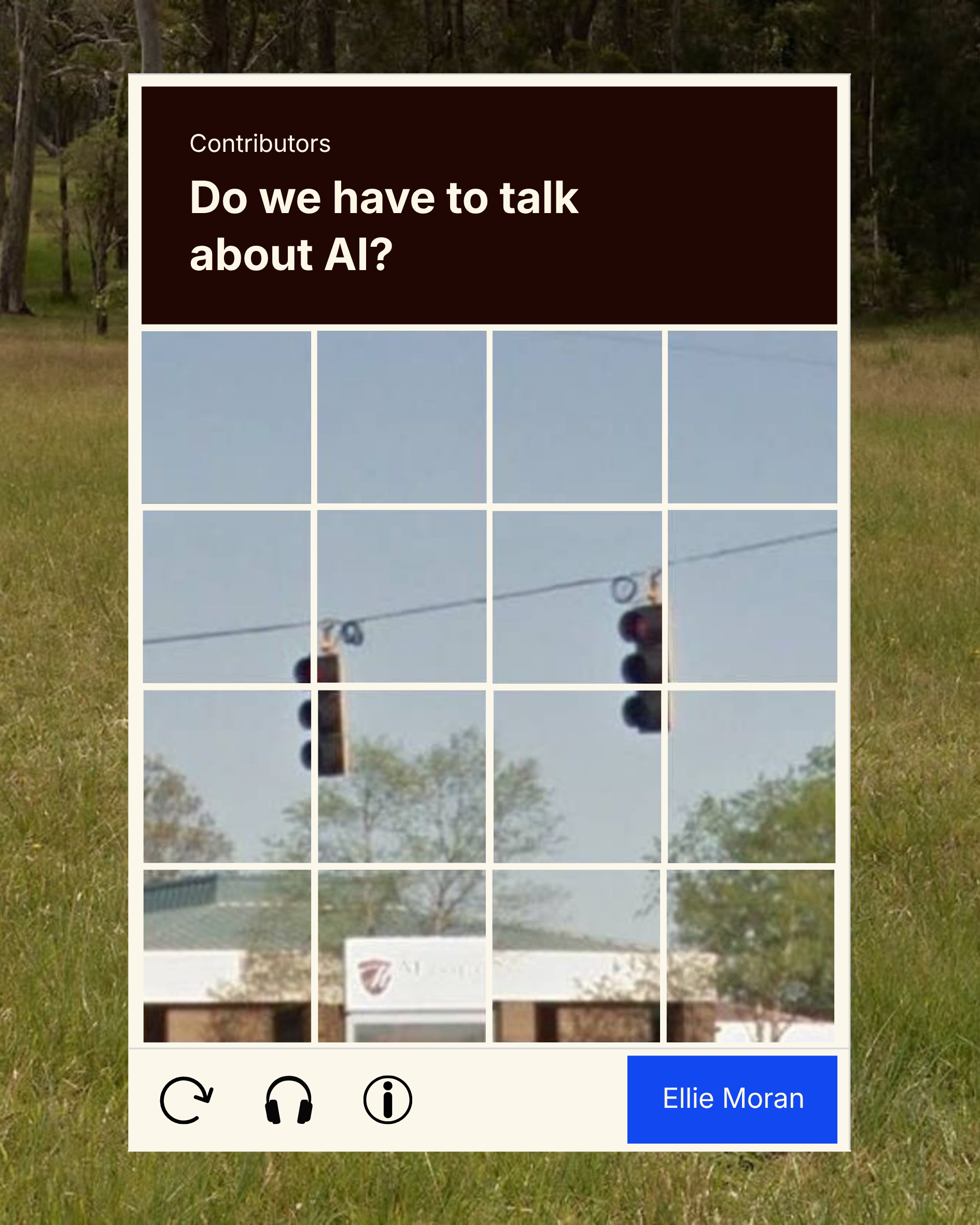
The human experience has always lived in the gaps; within the unpolished and the incomplete. Sometimes it’s as small as being presented with a grid of randomised images and having the capability to pick out which have traffic lights in them. But more commonly, it’s perspective. Being able to see the universe from the center of our being, outwards. Filtering every interaction through memory and instinct. AI can imitate these things convincingly, but it does not carry them. It can only assemble a version of humanity from what we choose to give it.
When I started my corporate job, I didn't expect the degree to which AI wouldn't just be encouraged, it would be expected. Quietly mandated. The rationale is straightforward enough: AI creates efficient workers and greater output. It takes the labour out of thinking and rewards faster turnaround. From a business perspective, it makes complete sense. From a human one, it's worth interrogating.
Because here's what that looks like in practice. I’ve found myself second-guessing a simple email reply. Is my tone professional enough? Will it land the way I mean it to? I run it by Claude just to ‘double check’ and then catch myself wondering whether the person on the other end is using AI to read it anyway. We're both outsourcing the same interaction to the same kind of tool, and calling it communication. The irony is that in trying to sound more human, we're becoming less so.
Once it became expected at work, the line began to blur at home and I began using it for everything outside of work too. Grocery lists, budgeting my expenses to include a glass of wine on the weekend, coming up with to-do lists; all things that can be done using my own thinking, but why not make it quicker!
I want to feel less guilty about it. Less guilty for being coerced into adopting it. Less guilty for being on my phone too much, for letting a robot help structure my thoughts, for using it to turn my amalgamation of ideas into something easily consumable. In search of a justification for using it outside of work, I hoped the act of writing about it would provide one.
What I've landed on instead is something more uncomfortable: there is no clean way to justify it, not really. Not when it slowly becomes smart enough – at no one's fault but my own – to emulate the voice I’ve been carefully curating for years. Perhaps that’s the point of the discomfort. The discomfort is the only honest thing left in the space where most people are quietly doing the same without saying so. Is that where the guilt lives? Not in the using, but the hiding. It’s becoming a kind of moral tax we pay for convenience.
When using AI, I’ve noticed it has made it easier to narrow my thoughts into something more legible. Whether that's a good thing or a bad thing, I'm genuinely not sure. There’s still something it lacks: a sense of lived experience, which can’t be simplified into a written prompt. AI arrived at an eerily convenient time, at the precise moment we became technologically fatigued enough to welcome something that would do the heavy lifting for us; just as we hit peak burnout, peak overstimulation and peak ‘I cannot write one more email from scratch’. I'm not saying it was engineered that way, I'm just saying the timing is interesting and once you start pulling that thread, it's hard to know how far down the rabbit hole you're willing to go. And if the human experience has always lived in the gaps, I’m not sure what we become when we start closing them.